



You can usually spot the new HVAC students on the first day. They walk into the lab expecting to fix an air conditioner before lunch. Instead, they spend time learning where every tool belongs, how to stay safe around electrical equipment, and why rushing through the basics can create bigger problems later. That surprises a lot of people.
HVAC certification training is not about memorizing a textbook. It is about learning how heating and cooling systems work, building good habits, and becoming comfortable with equipment that may have looked intimidating only a few days earlier. Every lesson builds on the one before it. By the time you begin troubleshooting real systems, you already understand why each step matters.
If you are thinking about HVAC certification training in Texas, here is what you can expect from the experience.
Why Students Choose HVAC Certification Training in Texas
In Texas, heating and cooling systems are part of everyday life. Air conditioning runs for much of the year, and homes, offices, schools, and businesses all depend on HVAC systems working properly.
Many students choose HVAC because they want something different from a traditional classroom experience. They like solving problems with their hands. They enjoy seeing immediate results after fixing an issue. Others simply want to learn a skill that people rely on every day.
Regardless of what brings you into the classroom, the first goal is the same: learn the fundamentals before moving into more advanced work. That foundation becomes important later when you begin diagnosing problems instead of simply replacing parts.
The First Week Usually Looks Different Than You Expect
Many new students expect to spend their first day repairing furnaces or replacing compressors. That usually is not how training begins.
You Do Not Start by Repairing Air Conditioners
Your instructor may begin with shop rules, personal protective equipment, and how to safely use common HVAC tools. You also become familiar with the equipment around the lab.
Instead of seeing one large HVAC system, you begin recognizing individual components.
- Compressors
- Condensers
- Evaporator coils
- Thermostats
- Blower motors
At first they may all look unfamiliar. After a few weeks, you naturally recognize each one. This slower start helps you build confidence before working on complete systems.
Everyone Starts Somewhere
One thing that surprises many students is how different everyone’s background is. Someone in your class may have spent years working construction. Another student may have never used a cordless drill before. That difference usually disappears quickly.
Instructors demonstrate each task before students practice it themselves. Questions are encouraged, and mistakes become part of the learning process instead of something to avoid. Nobody expects perfection during the first week.
What You Actually Learn During HVAC Certification Training
As training moves forward, each lesson begins connecting to the next. Instead of isolated topics, you start seeing how an entire HVAC system works together.
Learning How Heating and Cooling Systems Work
One of the biggest changes for new students is learning to think of an HVAC system as one connected process. The thermostat calls for cooling. Electrical components respond. The compressor starts. Refrigerant moves through the system. Air flows across the evaporator coil. Cool air enters the room. Instead of memorizing individual parts, you begin understanding how they work together. That makes troubleshooting much easier later.
Becoming Comfortable Around Electrical Systems
Electricity makes many students nervous. That is completely normal. Rather than jumping into advanced diagnostics, instructors first teach safe testing procedures. You learn how to use a multimeter, identify electrical components, and follow wiring diagrams one step at a time. Eventually, those confusing bundles of colored wires begin making sense. You stop guessing and start following a logical process.
Understanding Refrigeration Principles
At first, refrigeration can feel like learning a new language. Pressure changes. Temperature changes. Refrigerant changes state. Those ideas sound complicated until you begin watching them happen on actual equipment.
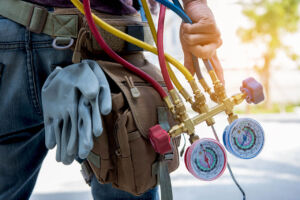
Students often remember the first time they connect manifold gauges and watch system pressures respond while the equipment operates. Suddenly, the numbers on the gauges tell a story. Instead of memorizing charts, you begin understanding what the system is trying to tell you.
Learning to Use HVAC Tools
Every trade has tools that become second nature over time. HVAC students spend time learning how to properly use equipment such as:
- Digital multimeters
- Manifold gauge sets
- Vacuum pumps
- Refrigerant recovery equipment
- Hand tools used throughout the trade
At first, every tool feels unfamiliar. After enough repetition, reaching for the correct tool becomes automatic.
Expect to Spend More Time Working Than Watching
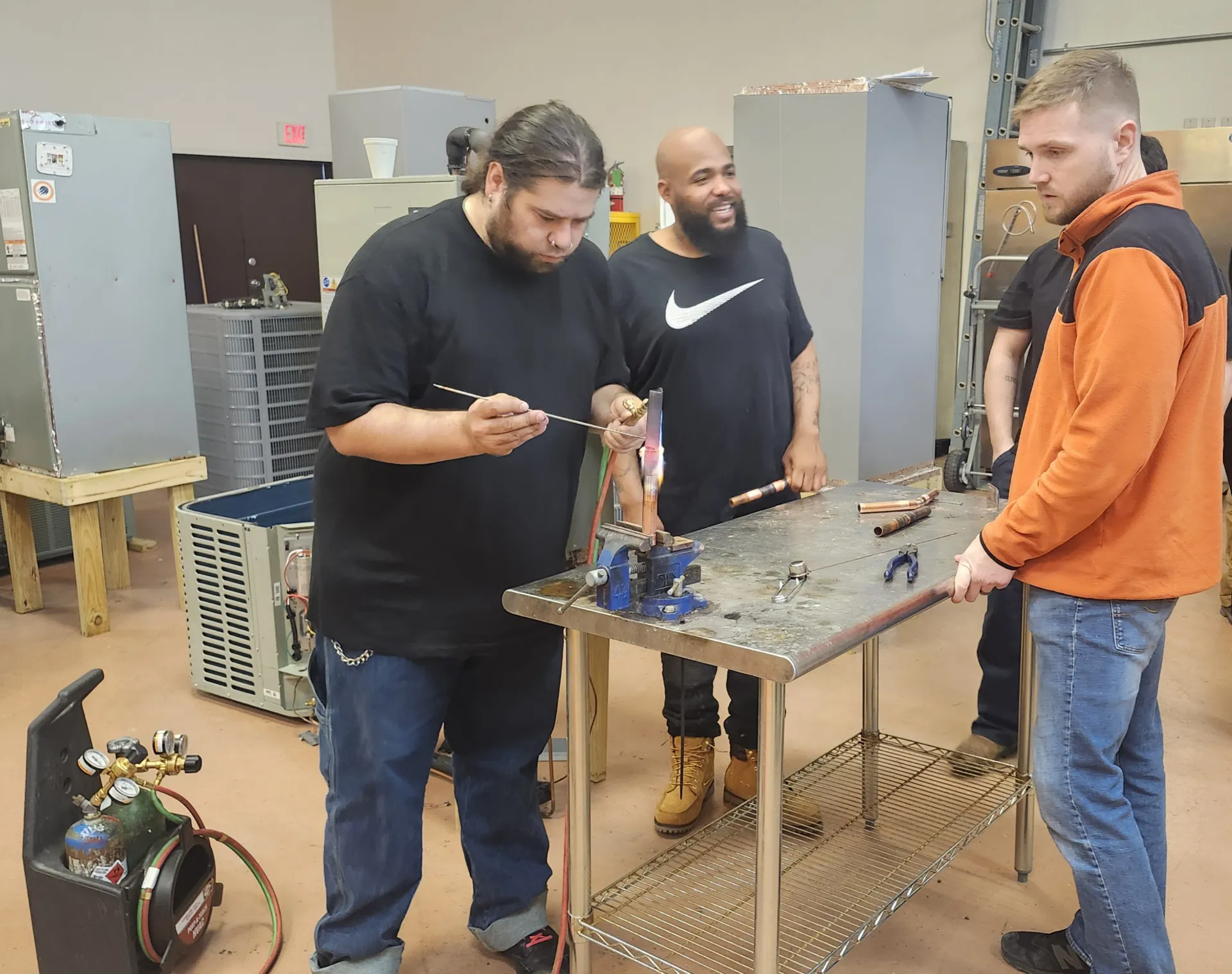
One thing students notice quickly is that HVAC training is very hands-on. An instructor may explain a new concept for a short time, but much of the learning happens in the lab. A typical exercise might begin with an instructor demonstrating a procedure. Then students repeat it.
Someone forgets a step. Another student connects the wrong wire. The instructor walks over, explains what happened, and everyone tries again. That cycle repeats throughout training.
Those small corrections build confidence much faster than simply reading about HVAC systems. Many students discover that they remember a lesson better after making a mistake and correcting it themselves.
Preparing for EPA Certification
If you plan to work with refrigerants, EPA 608 certification becomes an important part of your training. Students spend time learning proper refrigerant handling procedures, environmental regulations, recovery methods, and safety practices before taking the certification exam.
The goal is not simply passing a test. It is understanding why those procedures exist. Once you understand the reasons behind the rules, the information becomes much easier to remember. Practice exams also help students become comfortable with the testing format before exam day arrives.
What Students Usually Find Most Challenging
Every student has one topic that takes a little longer to understand. That is normal.
Reading Wiring Diagrams
Many new students look at their first wiring diagram and see nothing but lines and symbols. Then an instructor explains how electricity flows through the circuit. The diagram begins making more sense. A few weeks later, students often find themselves tracing circuits without realizing how much they have improved.
Following the Order of Operations
HVAC systems follow predictable sequences. If one step does not happen, the next one usually cannot happen either. Learning that sequence takes practice. Many troubleshooting exercises become easier once students learn to slow down and ask one question at a time instead of jumping straight to conclusions.
Building Confidence
Confidence usually arrives quietly. It may happen the first time you correctly diagnose a faulty capacitor. Or the first time your instructor watches you complete a procedure without offering help. Those moments stand out because you remember how uncertain everything felt only a few weeks earlier.
What Happens After HVAC Certification Training
Finishing your HVAC certification training does not mean you know everything. It means you have built a strong foundation. You understand how to approach a problem logically. You know how to work safely. You recognize the major components of heating and cooling systems, practiced using the tools found in the field, and have spent time troubleshooting equipment instead of simply reading about it.
That foundation helps make the transition from the classroom to the workplace much smoother. Experienced technicians continue learning throughout their careers. New equipment appears. Technology changes. Every service call presents something a little different.
Training gives you the confidence to walk into that first job knowing how to think through a problem one step at a time.
Frequently Asked Questions (FAQs)
How long does HVAC certification training take in Texas?
Program length depends on the school and curriculum. Many HVAC certification programs can be completed in less than a year, allowing students to begin looking for entry-level opportunities sooner than many traditional degree programs. The HVAC program at CyberTex can be completed in 11 months attending full-time.
Do I need HVAC experience before enrolling?
No. Many CyberTex students begin with little or no experience using HVAC tools or working with heating and cooling systems. Training starts with the fundamentals before introducing more advanced concepts.
Is HVAC certification training mostly hands-on?
Yes. CyberTex HVAC Technician Diploma combines classroom instruction with hands-on lab experience. Students learn concepts in class and then practice those skills on HVAC equipment.
Will I prepare for EPA certification during training?
Many HVAC programs include preparation for the EPA certification required to handle refrigerants safely. Check with your school to see which EPA certification exams are included.
What tools will I learn to use?
Students commonly work with multimeters, manifold gauge sets, vacuum pumps, recovery equipment, and other hand tools used during HVAC service and repair.
What is the biggest adjustment for new HVAC students?
Many students say the biggest adjustment is learning to troubleshoot instead of guessing. Training teaches you to slow down, follow a process, and use test results to identify the real cause of a problem rather than replacing parts at random.
HVAC Technician Diploma
Want to achieve HVAC certifications to start a rewarding career as an HVAC technician in Texas? With more than two decades of success in the medical, health, and IT sectors, we added an HVAC course to our curriculum. We proudly announce that we have flexible day and evening classes for the HVAC program.
CyberTex’s HVAC program can be completed in as little as 11 months by attending full-time with the flexibility of day and evening classes. You can take the EPA–608 certification from the US Environmental Protection Agency with our training.
Want to learn more? Contact us today.